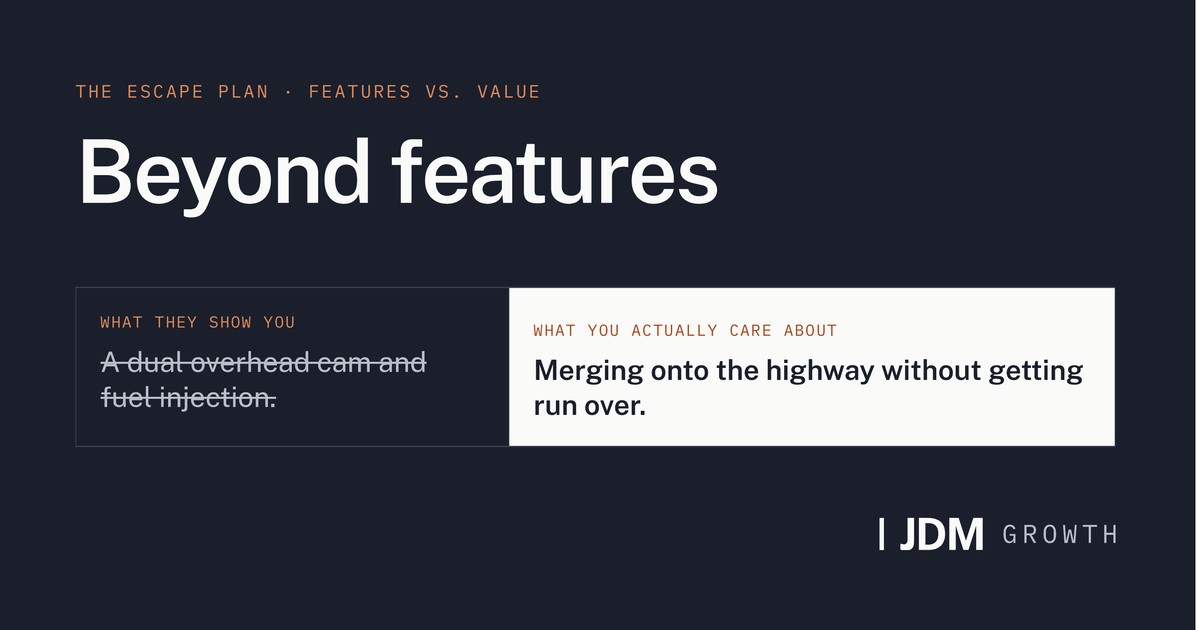
Imagine you are buying a car. The salesperson pops the hood and proudly points out the dual overhead cam and the fuel-injected engine.
That is a feature. But what you actually care about is the value. You want to know that this car will accelerate fast enough so you can merge onto the highway without getting run over.
Falling in love with features
Founders and product teams pour their blood and sweat into building new tools. They naturally fall in love with their own features. They obsess over what the product does. It is only natural to want to tell the world how it works and why it is technically superior.
But technical superiority is not sufficient.
Simon Sinek wrote an entire book about the missing piece. You have to start with Why. And "Why" is the absolute crux of value.
Your prospects don't care about your features.
They also don't really care about your founding story.
The buyer defines value
Put yourself in their shoes for a minute. They have a business to run. They have problems to solve, people to hire, and tasks a mile long. Your tool is not on their radar until it solves a specific problem.
Value is subjective. The buyer is always right (they define what's valuable). They only pay for your solution because of the measurable impact it brings to their organization.
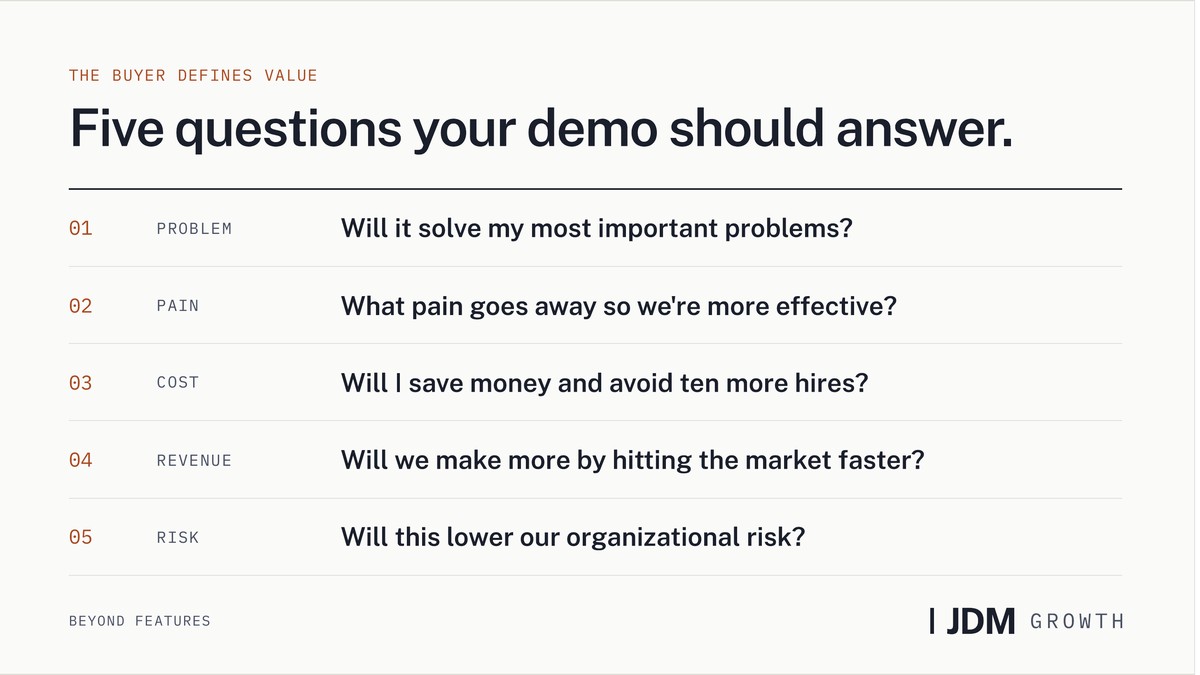
So what does a prospect actually need to hear?
- How will this solution solve my most important problems?
- What specific pain will it alleviate so we can be more effective?
- Will I save money and avoid hiring ten more people?
- Will I make more money because we will hit the market faster?
- Will this lower our organizational risk?
I have lost track of how many sales demos I have sat through where I had to play value detective. The rep spends an hour showing me exactly what the software does. But they leave it up to me to connect the dots and articulate the actual value. It can be a massive failure.
Value belongs in every interaction
Value is not just about the product messaging and positioning. It's more fundamental than that. It has to be baked into your marketing content.
Consider a typical B2B whitepaper. Marketing invests in building a document that is 100% focused on a new product capability. It eloquently describes what the feature does and why it beats the competition.
But where is the value to the reader? There is none.
Or consider the automated email promoting your next webinar. Is there actual insight in that email, or is it just a digital flyer?
You need to strive to deliver value with every single interaction. A whitepaper should help the reader understand and solve a specific challenge. It should deliver value even if they never buy your product. Emails should provide new information or actionable insight.
You have to earn the right to call them to action. The only difference between spam and good engagement is value.
Take a hard look
So take a hard look at your current go-to-market execution.
Does your website clearly communicate business benefits, or is it a list of technical specs? Listen to your sales calls. Do your reps start by talking about your founders, or do they start with true discovery to uncover actual pain?
You cannot deliver value if you do not know whose pain you are trying to solve. Which leads to the next critical question. Who are you actually selling to, and what do you really know about them?
Recognize your week in this?
A Customer Truth Sprint shows you what your market is actually telling you in 14 days. Start with a conversation about where your pipeline is sticking.
Start a conversation